
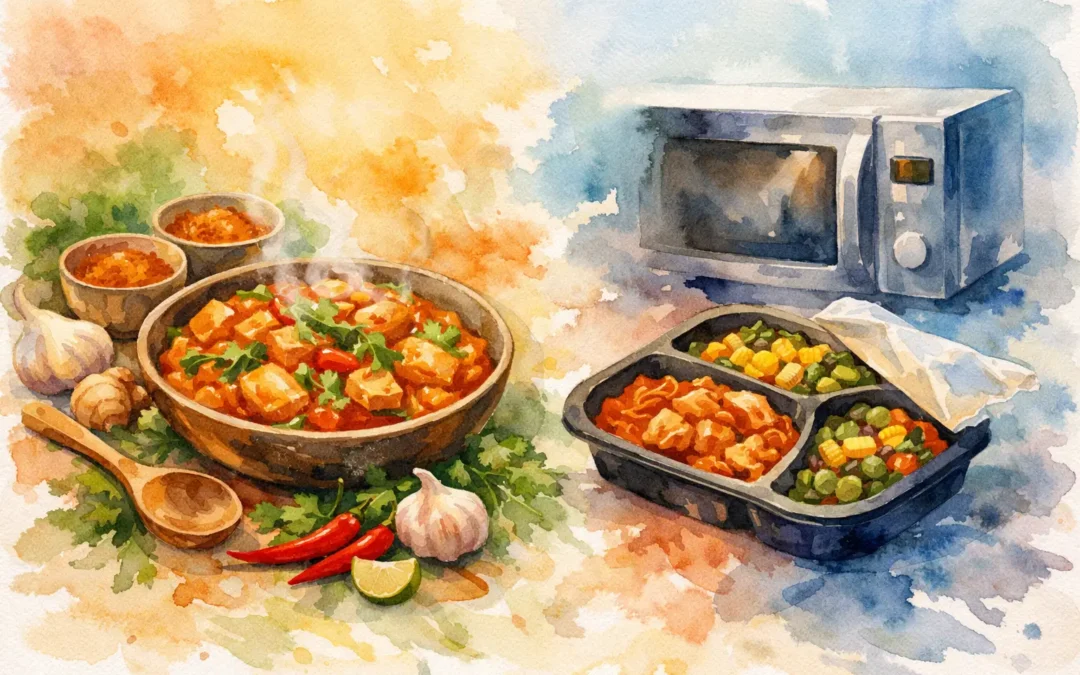
It usually happens on a busy evening. You open the fridge, spot a ready meal, then wonder whether ordering a fresh curry would be the better shout. When it comes to fresh curry vs ready meals, the real difference is not only taste. It is also about ingredients, value, portion quality, and how satisfying dinner feels when it finally lands on the table.
For plenty of households, ready meals win on speed. They are there, they are simple, and they do a job when time is tight. But if you are choosing dinner based on flavour, freshness and proper value for money, a freshly cooked curry often comes out well ahead.
Fresh curry vs ready meals on flavour
This is where the gap is usually easiest to notice. A fresh curry has life to it. You can taste the layers – onions cooked down properly, garlic and ginger with a bit of bite, tomatoes that still bring brightness, and spices that have not faded into the background.
Ready meals tend to be built for shelf life or repeated chilling, transport and reheating. That often means the sauce is flatter, sweeter or saltier than it needs to be. Heat can feel one-dimensional too. Instead of balanced spice, you get a general warmth with less depth behind it.
A fresh curry should taste like it has been cooked, not processed. The difference is especially clear in dishes where the sauce matters as much as the main ingredient. A tikka masala should be creamy without becoming heavy. A jalfrezi should have edge and freshness. A bhuna should feel rich and concentrated, not thickened for the sake of it.
Ingredients make a bigger difference than people think
Fresh daily cooking changes the whole result. Hand-prepared onions, fresh chillies, herbs and proper spice blends bring out the character of a dish in a way packaged meals rarely manage.
That is not to say every ready meal is poor. Some are decent for what they are, especially the more premium ones. But they still work within the limits of factory production, packaging and reheating. Texture suffers first. Chicken can become a little rubbery, vegetables lose their shape, and sauces often need stabilisers or extra processing to stay consistent in a tray.
With fresh curry, ingredients are chosen for eating now, not sitting in a package. That matters. You notice it in the tenderness of the meat, the texture of paneer, the bite of peppers, and the aroma that rises the moment the lid comes off.
Convenience is not as one-sided as it used to be
Ready meals built their reputation on ease, and fair enough – they are hard to beat if dinner must come straight from the freezer to the microwave. But convenience has changed. Ordering a freshly cooked takeaway or arranging click and collect is now part of everyday life for many people.
That shifts the comparison. The question is no longer simply, what is quickest from the supermarket shelf? It is also, what gives you a proper meal without much effort? If you can order a fresh curry for collection or delivery, the convenience gap narrows fast.
For families, couples and working adults, that matters. You still avoid the shopping, prep and washing up, but you get food cooked with far more care. It is convenience without settling for something that feels like a backup plan.
Fresh curry vs ready meals on value
Price is where people often assume ready meals are better. On the surface, they can look cheaper. But value is not the same as the lowest number on the packet.
A fresh curry usually delivers more in portion quality, flavour and satisfaction. If a ready meal leaves you adding naan, rice, snacks or something extra because it does not quite hit the spot, the saving starts to shrink. Premium ready meals can also become surprisingly expensive once you buy sides, drinks or enough portions for everyone.
Freshly cooked food tends to feel more complete. The portion is more generous, the sauce tastes fuller, and the meal feels like a proper treat rather than a compromise. That can make the price easier to justify, especially when you want dinner to be enjoyable as well as practical.
There is also the matter of consistency. A dependable local takeaway or restaurant gives you a clearer idea of what you are paying for. You know the style, the quality and the portion. With ready meals, two products at the same price can vary wildly.
Texture is where ready meals struggle most
People often talk about flavour first, but texture is just as important. A curry is not meant to be one soft, uniform spoonful after another. The best ones have contrast. Tender chicken, a sauce with body, onions with softness but still some structure, and vegetables that have not been cooked past their best.
Ready meals often lose that contrast. Microwave reheating is convenient, but it is not kind to texture. Rice can dry at the edges and clump in the middle. Meat can toughen. Fried starters become limp. Even when the flavour is acceptable, the eating experience can feel flat.
Fresh curry holds up better because it starts from a stronger point. It has been cooked for service, not designed around packaging. That simple difference is why a fresh meal feels more restaurant-like and less functional.
It depends on what kind of evening you are having
There are times when a ready meal makes sense. If you are eating alone very late, trying to keep costs tightly controlled, or need something on hand for emergencies, keeping one in the freezer is sensible. Nobody needs to pretend otherwise.
But there is a big difference between useful and enjoyable. If it is Friday night, if the family is choosing together, if friends are coming round, or if you simply want dinner to feel worth looking forward to, fresh curry is usually the better answer.
That is especially true when Indian food is involved. Curries are built on aroma, spice balance and freshly cooked sauces. They are at their best when served close to the moment they are finished. Reheated versions can imitate the look, but rarely the full experience.
Why fresh daily cooking matters
Fresh daily cooking is not just a nice phrase. It affects everything from taste to consistency. When ingredients are prepared each day, dishes keep their character. Coriander tastes brighter. Onion bases taste sweeter and deeper. Spice blends smell warmer and more inviting.
It also means the food feels more honest. You can tell when a curry has been made with care rather than assembled for volume. The result is more dependable and, for most people, more memorable.
That is one reason local customers keep coming back to places that focus on freshness, authentic Indian spices and reasonable price. At Worthing Indian Cafe & Bar, that balance matters – giving people food that is vibrant, approachable and suitable for both a quick weekday takeaway and a more relaxed meal.
The better choice for groups, families and sharing
Ready meals are usually designed for one person, sometimes two at a stretch. They are not ideal for shared dining. A fresh curry meal works differently. You can mix dishes, add rice and breads, include starters, and give everyone something they actually want.
That flexibility is part of the appeal. One person can choose a creamy classic, another can go for something hotter, and the table still feels connected. It turns dinner into more than fuel. It becomes part of the evening.
For families, that can be the difference between serving separate trays and enjoying one proper meal together. For couples, it feels more like a night in with purpose. For small gatherings, it is an easy way to feed everyone well without cooking from scratch.
So which wins?
If the only measure is whether food can be heated in minutes, ready meals still have a place. They are practical, easy to store and useful when options are limited. But on the things most people care about once dinner is actually served – flavour, freshness, texture, satisfaction and overall value – fresh curry is hard to beat.
A good meal should feel like more than a shortcut. It should taste fresh, smell inviting and leave you glad you chose it. If that is what you want from dinner, fresh curry is usually the stronger option, and a much better way to end the day.